
Ivy on trees: when to leave it and when to ask for advice
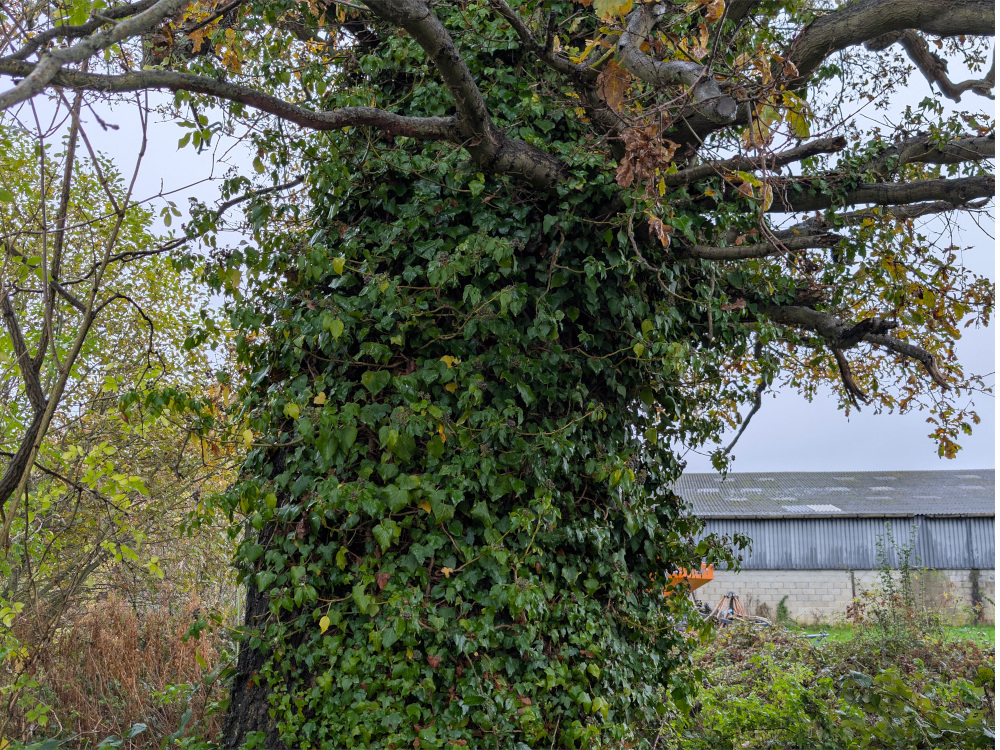
This guide adapts Sarah Gwilliam’s original article, published on 19 November 2024. Updated on 21 September 2026.
Ivy climbing a tree can prompt an immediate urge to cut it away. Before reaching for tools, pause and consider what you are trying to achieve. Is the concern the appearance of the trunk, growth spreading across a border, or something about the tree itself? Those are different questions, and they do not all call for complete removal.
Ivy does not automatically mean a tree is in trouble
The RHS guidance on ivy and trees explains that ivy does not directly harm trees. Its climbing roots attach it to a surface; they do not mean that it is feeding from the tree. Healthy trees can coexist with ivy.
Dense growth can make inspection harder by hiding parts of the trunk and branches. That is a reason to consider the individual situation, rather than proof that ivy caused any decline. A thinning crown or damaged branch needs to be understood on its own merits. Do not assume that removing ivy will cure an unrelated problem.
Consider what the ivy contributes
Ivy is also a useful wildlife plant. The RHS ivy guide describes its shelter value, late-season flowers and winter berries. That matters when deciding whether growth can be retained in one part of a garden while being controlled somewhere else.
A completely bare trunk is not the only possible outcome. You might want to keep a path clear, prevent growth entering a bed, or make a particular part of a tree easier to inspect. Describe that aim first. It helps avoid unnecessary work and makes a discussion about maintenance more useful.
Look from the ground before making a plan
Take a few photographs from a safe position: the whole tree, the lower trunk and the surrounding space. Note whether ivy is mainly on the trunk or extends into the crown, and whether the concern has developed recently. Include nearby paths, seating areas or buildings in your description.
Do not climb a ladder against the tree to obtain a better photograph. If you can see damaged or hanging branches, avoid the area beneath them. Photographs can help explain a concern, but they cannot establish that a tree is safe or show everything hidden by dense growth.
Avoid a rushed removal attempt
Our earlier article described a general removal sequence. This revision takes a more cautious approach: there is no single set of cutting instructions that is right for every tree and every amount of ivy. Pulling established climbing growth away can damage bark or bring material down unexpectedly.
Before any work, consider wildlife using the vegetation and whether further advice is needed about the tree or the proposed work. Where ivy is high in the crown, stems are substantial, or the tree’s condition is uncertain, ask for an assessment rather than treating it as a routine gardening job. This guide does not recommend climbing, power-tool use or chemical treatment.
Make your enquiry specific
Tell us where the tree is, what worries you and what you would like to change. Mention access restrictions and whether the work is about the tree, the ivy at ground level, or both. That is more useful than requesting removal before the situation has been discussed.
Read about tree surgery or garden clearance, then contact us to discuss your garden. Keeping useful ivy and managing unwanted growth can both be reasonable aims; the starting point is understanding your tree and garden.
Get a free quote
No pressure, no obligation — just honest advice and a written price.